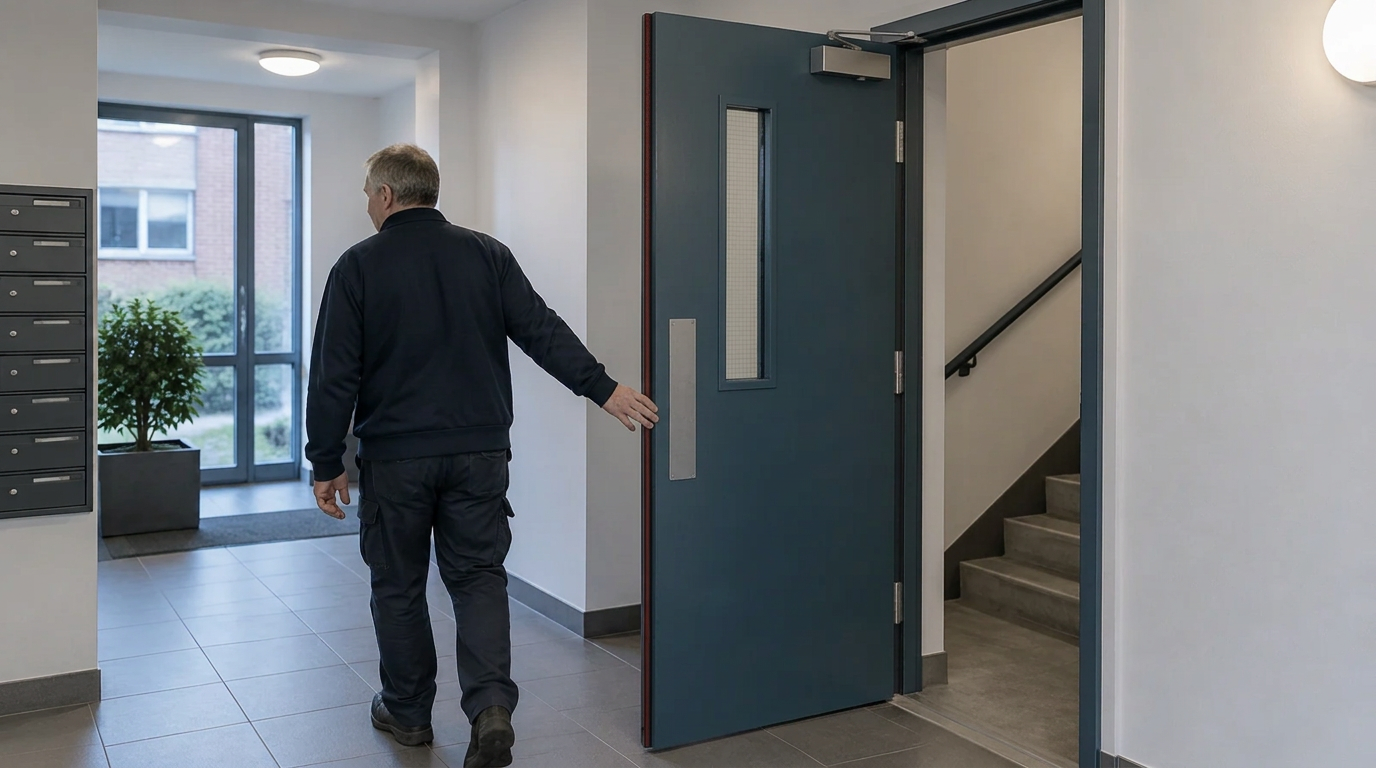
Fire door checks in blocks of flats: what Regulation 10 requires
If you're the responsible person for a block of flats in England, and its top storey is more than 11 metres above ground, the law requires you to check the communal fire doors at least every 3 months and to use best endeavours to check every flat entrance door at least once a year. This guide explains which buildings are covered, what to check, who can do it, and what to record.
The law
- The Regulatory Reform (Fire Safety) Order 2005 requires the responsible person to keep fire safety measures, including fire doors, in efficient working order and good repair.
- The Fire Safety Act 2021 confirmed that the Order covers the entrance doors of flats that open onto the common parts, as well as the communal doors.
- Regulation 10 of the Fire Safety (England) Regulations 2022, in force since 23 January 2023, adds specific duties. In every block with two or more flats and common parts, residents must be told to keep fire doors shut, not to tamper with self-closing devices, and to report faults or damage straight away.
- Where the top storey is more than 11 metres above ground, the responsible person must also check any fire doors in the communal areas at least every 3 months, and use best endeavours to check the entrance door of every flat at least every 12 months. Both checks must include making sure the self-closing devices are working, and a record must be kept of the steps taken to check flat entrance doors.
Which buildings are covered
- Buildings in England with two or more flats, where the top storey is more than 11 metres above ground. Height is measured to the floor of the top storey, not to the roof. Government guidance says this is typically a building of more than four storeys.
- The duty sits with the responsible person: usually the freeholder, the residents' management company or right to manage company, or a managing agent acting for them.
- Below 11 metres, the 3-monthly and yearly checks aren't required by Regulation 10. But fire doors must still be kept in good repair, residents must still be given fire door information, and your fire risk assessment may recommend regular checks.
Who can do the checks
The government's guidance says the Regulation 10 checks should be simple and basic, and that you shouldn't need a specialist to carry them out. They're visual and don't involve tools. With the right instruction, caretakers, managing agents, housing officers and maintenance staff should be able to do them, for example during other routine visits to the building.
Any repair or replacement the checks find must be carried out by a competent contractor as soon as reasonably practicable. The checks also don't replace periodic assessment of your fire doors by a specialist, for example on a sampling basis during your fire risk assessment.
What to check on each door
Based on the government's guidance, each check should confirm that:
- there's no damage, defect or alteration to the door, frame or surrounding wall that could affect its ability to hold back fire and smoke, such as a split in a timber door, warping that stops it fitting its frame, or a hole where a lock has been removed;
- any fire-resisting glass in the door, and in any side or over panels, is undamaged;
- the hinges and other ironmongery have no obvious defects, such as missing or loose screws;
- intumescent strips and smoke seals, if fitted, are undamaged, touch the door or frame, and haven't been painted over;
- the gap between the door and frame is no more than 4mm at the sides and top, with the gap at the bottom as small as practicable; and
- the self-closing device shuts the door fully into its frame. Open the door fully and let it go, then open it to about 15 degrees and let it go. Both times it should close fully, overcoming any latch or friction with the floor.
For flat entrance doors, check from both sides. Also check that the door hasn't been replaced with one that may not be fire-resisting, and that any letterbox closes firmly and isn't jammed open.
Different types of communal door
- Stair, lobby and corridor doors get the most wear, so the guidance suggests keeping an eye on them whenever you visit the building, as well as at the 3-monthly check.
- Doors held open on magnetic hold-open devices should be released with the test button, where there is one, rather than pulled off the magnet.
- Double doors with a door selector should close in the right order.
- Doors to plant rooms, cupboards and risers also need checking every 3 months, including any air transfer grilles. They may be self-closing or kept locked shut. Take care entering these areas.
What the checks aren't for
Regulation 10 checks are about keeping your existing doors working, not about whether they meet today's standards for new doors. That's a matter for your fire risk assessment. The government revised its guidance in 2025 to say that, in most cases, a flat entrance door that met the standards when the block was built, or when the door was made, will still give adequate protection if it's undamaged and the gaps aren't too large. A missing certificate, or missing intumescent strips and smoke seals, doesn't on its own mean a door is unfit.
Keep a record
Record each communal check round: the date, who did it, the result for every door, and what needs doing. Record each repair when it's done. For flat entrance doors, the law specifically requires a record of the steps you took, including your attempts to get access where a resident didn't let you in. A clear record is how you show the fire and rescue authority what you've done.
Enforcement
Your local fire and rescue authority enforces these duties. It can inspect, ask to see your records, serve enforcement notices and prosecute. A breach of the regulations is a criminal offence if it puts residents or others at risk of death or serious injury in a fire.
How Fire Door Check Log helps
Fire Door Check Log gives you a register of your fire doors, a checklist for each door on your phone, letters asking residents for access, a flat-by-flat log of every attempt, and PDF records for your fire safety file. It reminds you before each check is due.
£99 per building per year, whatever the number of doors or flats. See pricing
Fire Door Check Log helps you plan and record the routine checks. It doesn't inspect or certify fire doors, and it doesn't replace your fire risk assessment or a specialist inspection.
Sources: Fire Safety (England) Regulations 2022, regulation 10; GOV.UK Fire Safety (England) Regulations 2022: fire door guidance; Regulatory Reform (Fire Safety) Order 2005; Fire Safety Act 2021
Common questions
Do blocks under 11 metres need fire door checks?
Regulation 10's 3-monthly and yearly checks only apply where the top storey is more than 11 metres above ground. Below that, fire doors must still be kept in good repair under the Fire Safety Order, residents must still be given fire door information, and your fire risk assessment may recommend regular checks.
Can our caretaker do the checks?
Yes. Government guidance says caretakers, managing agents and maintenance staff should be able to do them with appropriate instruction, because they're simple visual checks that need no tools.
How do I check the gaps?
The guidance says the gap should never be more than 4mm, except at the bottom of the door, where it should be as small as practicable. A simple gap tester card makes this quick.
What if a door has no intumescent strips or smoke seals?
If they were never fitted, that may be acceptable, subject to your fire risk assessment. Don't replace a door for that reason alone. Raise it with your fire risk assessor.
What if a resident has replaced their front door?
Ask them to confirm the new door is fire-resisting and was fitted by a competent person, and to give you its technical information. Residents should agree any change to their front door with the responsible person first.